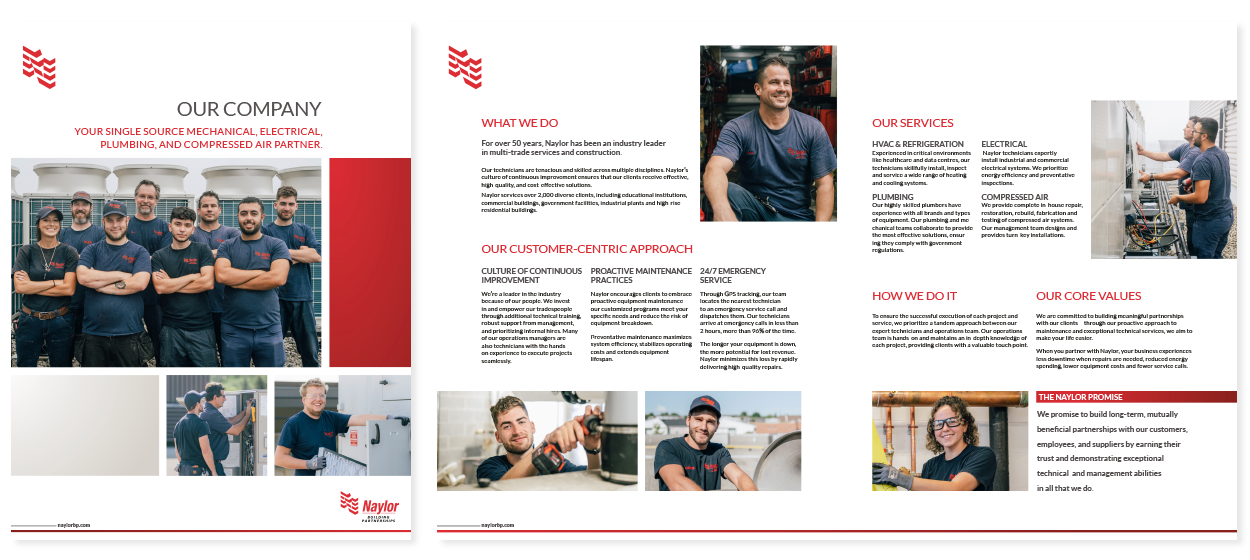
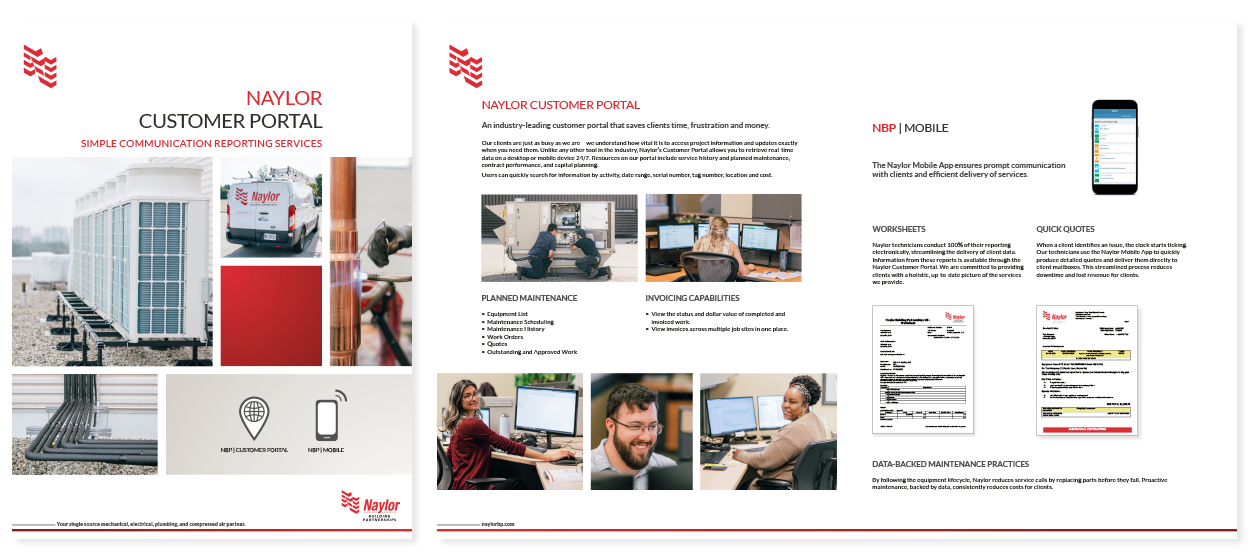
When we completed the brand refresh for Naylor Building Partnerships, the immediate goal was consistency and clarity. But Naylor was also preparing for growth and potential acquisition — and that context shaped every decision we made.
That foresight ended up mattering more than we anticipated.
Shortly after the refresh was complete, Naylor was acquired by Service Logic, a national platform that acquires and scales best-in-class mechanical service companies. What followed was a multi-year working relationship that extended well beyond the original project — one that tested the refresh in ways you can’t fully plan for.
Post-acquisition, the challenge shifted from building a brand system to adapting one.
Naylor needed to align with Service Logic’s broader visual and communication standards, but there was real value in not abandoning everything. Longtime clients recognized the Naylor brand. Internal teams had been working with it for months. And the company had decades of established equity tied to its name and identity.
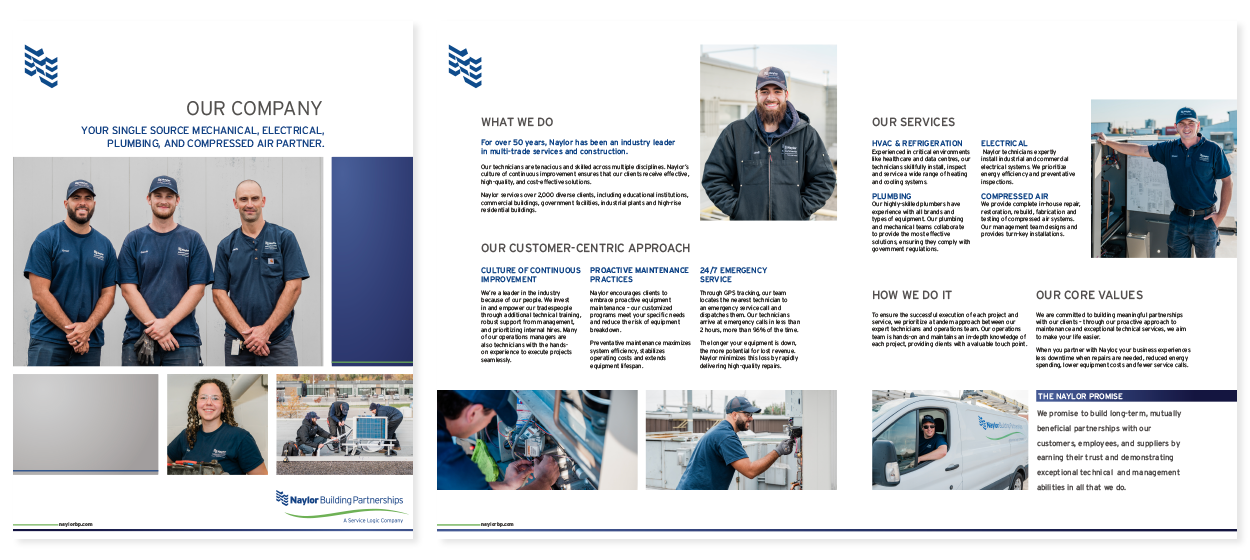
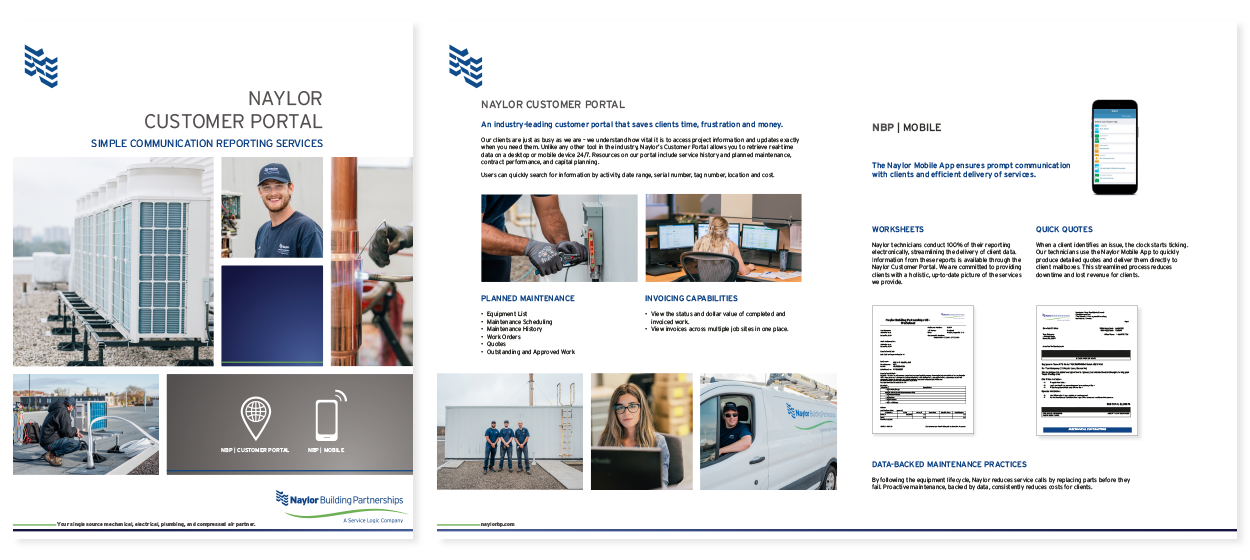
Rather than replacing the brand, we worked with Naylor and its new ownership to refine and extend what already existed. The goal was to bring the Naylor identity into alignment with Service Logic’s platform without making the transition jarring — for customers, or for the people inside the company navigating the change.
Because the original refresh had been built around systems rather than surface-level aesthetics, this wasn’t as difficult as it might have been. The structure was already there. We adapted it.
The before and after here tells the story of the acquisition in practical terms: the same documents, adapted to reflect Naylor’s new direction without losing what made the brand recognizable.
The more significant change came with Naylor’s U.S. division, which underwent a complete rebrand as part of the acquisition — emerging as an independent entity under a new name: National Mechanical Experts.
This wasn’t a refinement. It was a full separation. But that didn’t mean starting from zero.
The U.S. division needed a distinct identity — its own name, its own mark, its own presence in the market. At the same time, it was inheriting a client base that had spent years building a relationship with the Naylor brand. Walking away from that visual familiarity entirely would have made a business transition feel unnecessarily disorienting to the people who mattered most.
So the approach was deliberate: carry the visual language forward where it mattered. The document structure, layout, and overall aesthetic were kept close enough to what Naylor clients already recognized — familiar enough to ease the transition, distinct enough to stand on its own.
The result is a brand that stands on its own while making the transition as seamless as possible for the clients living through it. That’s not a design compromise — it’s the strategy.
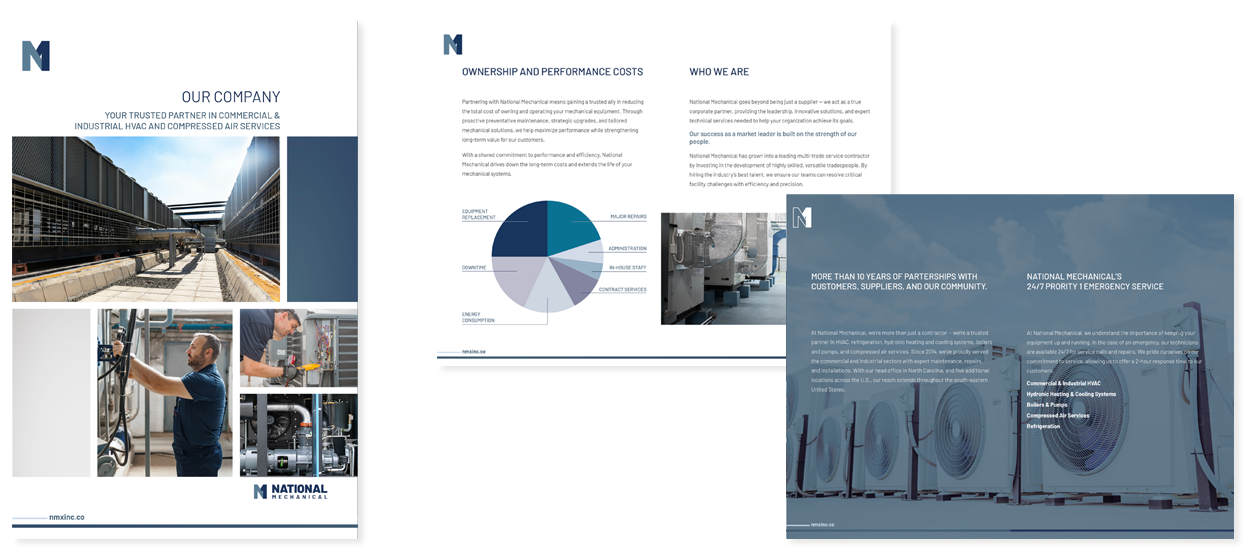
These examples show the National Mechanical identity in practice — the new mark alongside the corporate brochure that introduced the brand to the market. A new name and a new identity, built to feel familiar from day one.
This project unfolded over several years and included a refresh, an acquisition, a platform integration, and a full rebrand of an independent division. It’s probably the most complete illustration of what brand work is actually for.
A strong brand isn’t just something that looks good at launch. It’s something that holds up when circumstances change — when ownership shifts, when a division splits off, when a team that’s relied on something for decades suddenly has to adapt to something new.
The Naylor refresh solved an immediate problem. But because it was built with flexibility in mind, it also made every transition that followed a lot more manageable.
Related Case Study This project builds on the original Naylor Brand Refresh. How Branding Elevated Naylor Building Partnerships
Is your company preparing for growth, investment, or acquisition? Your brand should be an asset through that transition — not an obstacle.